Why handling quality matters, and why we don't measure it
Everyone agrees that how people handle cattle matters for animal welfare. How we measure and improve animal handling however is much more complex and represents a potential gap in our ability to offer a high quality of life for the animals under our care.

The importance of care
How a person moves around cattle, approaches them and interacts with them changes those animals' relationship with humans. It changes their affective state, absence or presence of fear, their stress physiology, their health and their yield.1 Across 66 commercial dairy farms, the number of forceful interactions used by stockpeople was correlated with lower milk yield, fat and protein, with higher milk cortisol, and with fewer cows willing to let a person approach.2,3 Aversive handling at milking also reduces milk let-down.4 In 2020 the Five Domains model5 (the framework the industry is now increasingly starting to adopt), was revised specifically to bring human interaction into welfare assessment in its own right within behavioural interactions.
We know that careful, calm and respectful handling of animals is the right thing to do, but how we measure and improve it deserves urgent consideration.
We measure handling quality at the end of the animal's life, and not before
Since 2018 every slaughterhouse in England has been legally required to run CCTV in all areas holding live animals.6 Footage is kept for 90 days, an independent Official Veterinarian has unrestricted access to it, and handling is scored against numbers. If more than 1% of animals fall while being handled, the audit is failed. The proportion of cattle vocalising during handling is capped in the low single digits.7 Any wilful act of abuse is an automatic failure whatever the other scores say.
However, all the years before that are covered by what is often a single scheduled farm visit per year and a training record.
The last few hours of life Watched continuously, scored numerically | Throughout lifetime Assessed annually, by appointment |
|---|---|
|
|
|
|
|
|
| |
|
Which of those two periods involves more handling?
This is not an argument that abattoirs are watched too closely. It is an observation that we have already accepted the principle of continuous observation and numeric scoring for handling. However, we only apply it to the end of an animal’s life.
A training record is an input, not an outcome
Farm assurance asks that staff are trained and demonstrably competent, usually evidenced by a record: induction date, tasks, prior experience, courses attended, certificates, training needs. Every one of those documents what was given to the person. None of them document what happened to the animal.
These standards reflect what could be measured when they were written. Handling was left as a paperwork item not because anyone thought paperwork was enough, but because until recently there was no practical way to observe it at scale. But the same logic would look odd anywhere else on the farm. Nobody accepts a hygiene certificate instead of a somatic cell count, or a trimming protocol instead of a mobility score. Twenty years ago the industry did accept exactly that for lameness. Then scoring was developed, then verification of the scorers, and the conversation moved on for good. Handling is roughly where lameness sat before mobility scoring existed.
Who is doing the handling
The Royal Association of British Dairy Farmers found 63% of dairy employers had struggled to recruit over the previous five years, up from 40% in 2014, and that only 31% of staff stay five years or more.8 Around three quarters of applicants arrive with some hands-on cattle experience, which means roughly a quarter arrive with none. Almost all employers offer training and most of it is on the job. Where training has been examined closely it is informal: in one US study of 95 milkers, 59% said they had been trained on the parlour equipment by another milker, and 11% by nobody at all.9
This is a sector under real labour pressure doing its best with the hours it has. But it does mean handling skill is copied from person to person, from a baseline nobody has measured, with nothing external to check it against. There is no mechanism for noticing drift.
Detection alone is not enough
The detection of poor handling is of course important, but is potentially the wrong metric to be measuring, for two reasons.
Firstly, in order to flag any potentially poor handling event, coverage would need to be of all areas: every gateway, race, collecting yard, pen and calving box. Even then, searching for rare events across a very large volume of ordinary footage produces false alarms faster than findings (even for a system with extremely high specificity), and people stop trusting the system.
Secondly, by the time a poor handling event has been detected, it’s already too late. By reactively identifying these events, we miss the opportunity to train and prevent.
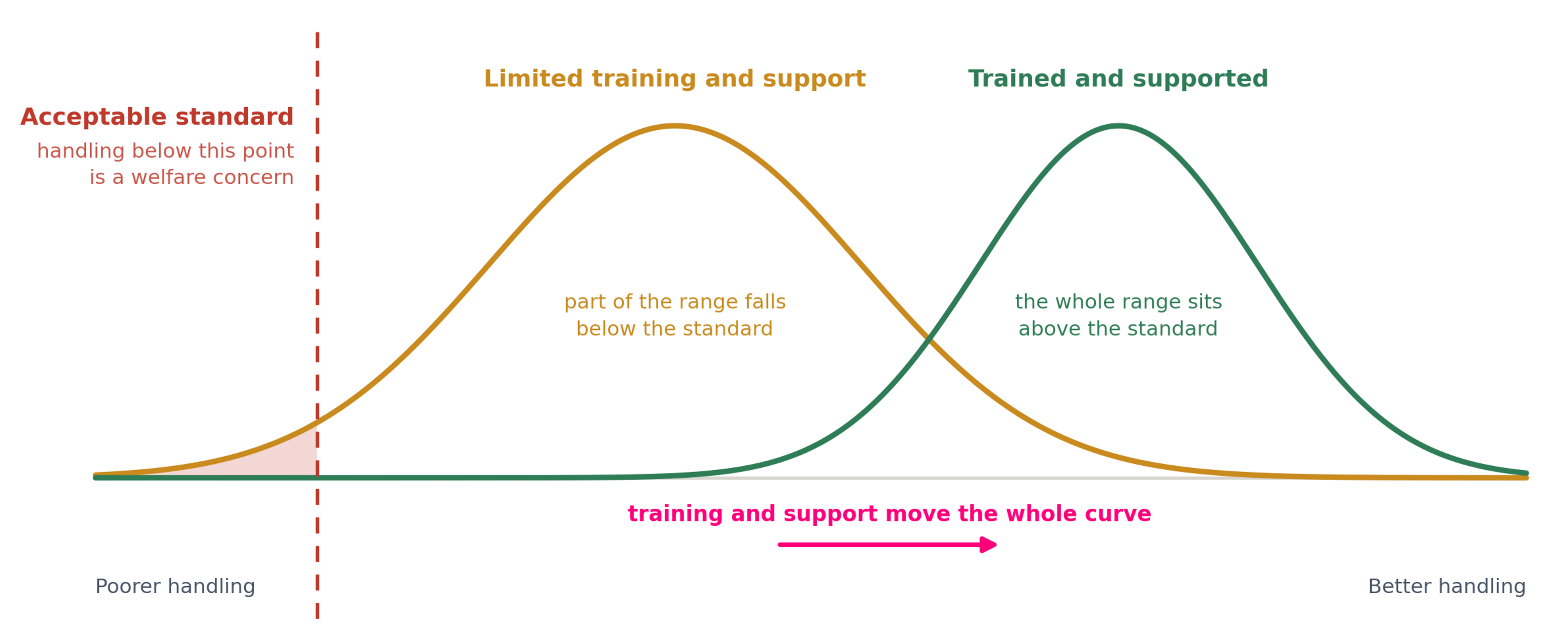
Handling competence is not a switch. It varies between people with training, experience and temperament, and within a person due to fatigue and workload. What matters is when a person’s handling skills fall below an acceptable standard (see Figure below). A well trained and well supported person will consistently perform above the acceptable standard whereas someone with little training will, at times, fall below it. This does not indicate deliberate cruelty, which is a different problem needing a different answer. The abattoir audits differentiate small misdemeanours from cruelty by grading ordinary handling on counted measures while treating any wilful act of abuse as an automatic failure that nothing else offsets. Anything built to measure on-farm cow handling would need to draw the same line.7
When nobody is watching, drift becomes culture
The past year has shown what the far end of that curve looks like, with some alarming examples. Systematic abuse is a different problem from ordinary competence variation, and it deserves the automatic-failure treatment the abattoir audits already give it. But it rarely appears from nowhere. Where handling is never measured, a team's norms can shift a long way before anyone inside notices, because there is no baseline to notice against. A culture of poor handling is not a collection of bad days. It is the whole curve, moved, with nobody watching it move.
The difficulty is that nobody knows where we are
We do not know where any given farm sits in terms of handling performance, because it has never been measured. We do not know the spread within a team, whether a farm has improved or slipped over five years, or how much of the variation is down to training rather than facilities.
It is also the reason to be optimistic. What gets measured gets improved. Mobility, mastitis, fertility and youngstock growth can of course all be further improved, but are generally in a better position since the sector agreed on a number and began comparing them. There is no obvious reason handling would behave differently, and reasonable evidence that it would not.
What is known to move it
Hemsworth and Coleman's ProHand programme works on what handlers believe about animals rather than technique alone. On dairy units it improved attitudes and roughly halved negative behaviour towards cattle. The effects on the cows themselves were smaller but real: flight distance fell by around 7%, milk cortisol by roughly a third, and yield rose by about 5%. Training changes people faster than it changes what animals have learned to expect, which is an argument for starting sooner.10
Measurement moves it further. Temple Grandin built commercial handling audits around simple counted outcomes, one of which is the proportion of cattle vocalising while being handled. Across plants doing the same job under the same rules, that figure ranged from around 1% to more than 30%. Where it was measured and reported back it fell: one site went from 4% to 1% once handling practice was reviewed, and others reached zero after straightforward changes to lighting and layout that removed the reason animals baulked in the first place.11,12 Mandatory CCTV has not, in itself, ended handling failures in abattoirs. What changed handling was a number: reviewed by someone competent, reported back, and then acted on.
Do we have a handling problem, or a handling measurement problem?
This is a complex topic, and an emotive one. It’s currently challenging to know what level of handling competence we have within, and between teams, and therefore even more challenging to make improvements.
If a customer asked today how well the animals in a supply chain were handled, the honest answer would be a training record rather than a number. Of the five domains, almost everything we can evidence continuously sits in the first three; the human interaction component within Domain 4 is largely absent. Nobody could currently say whether handling quality on a given farm had drifted over the past three years, because there is no baseline for it to drift from.
And when handling has gone wrong, the response has usually been that the person concerned no longer works there. That is a consequence rather than a control, and it arrives after the animal has already had the experience. A more proactive approach would look different: measure competence, feed it back, and train against it before anything goes wrong.
What would that measure look like? The abattoir model already gives most of the specification, and the technology that watches the last few hours of an animal's life is no longer confined to abattoirs. A workable measure would be continuous rather than annual, because handling happens every day and not by appointment. It would count outcomes in the animal rather than inputs to the person, the same principle behind vocalisation and slip scoring at slaughter. It would be built to shift the whole curve through feedback and training, not to catch the tail. And the judgement of whether an animal's welfare was compromised would stay with trained people.
None of that exists on farm today. All of it already exists, in some form, in an animal's last few hours. The gap is not conceptual. It is a measurement gap, and this industry has closed those before.
The behaviour with one of the biggest effects on how a dairy cow experiences her life is the behaviour nobody is watching. That seems worth changing.
References
- Hemsworth, P.H. & Coleman, G.J. (2011) Human-Livestock Interactions: the stockperson and the productivity and welfare of farmed animals, 2nd edn. CAB International, Wallingford.
- Hemsworth, P.H., Coleman, G.J., Barnett, J.L. & Borg, S. (2000) Relationships between human-animal interactions and productivity of commercial dairy cows. Journal of Animal Science 78, 2821-2831.
- Breuer, K., Hemsworth, P.H., Barnett, J.L., Matthews, L.R. & Coleman, G.J. (2000) Behavioural response to humans and the productivity of commercial dairy cows. Applied Animal Behaviour Science 66, 273-288.
- Rushen, J., de Passille, A.M.B. & Munksgaard, L. (1999) Fear of people by cows and effects on milk yield, behavior, and heart rate at milking. Journal of Dairy Science 82, 720-727.
- Mellor, D.J., Beausoleil, N.J., Littlewood, K.E., McLean, A.N., McGreevy, P.D., Jones, B. & Wilkins, C. (2020) The 2020 Five Domains Model: including human-animal interactions in assessments of animal welfare. Animals 10, 1870.
- The Mandatory Use of Closed Circuit Television in Slaughterhouses (England) Regulations 2018, SI 2018/556.
- Grandin, T. (2010) Auditing animal welfare at slaughter plants. Meat Science 86, 56-65; and Grandin, T. (ed.) (2019) Recommended Animal Handling Guidelines and Audit Guide, 2019 edn. North American Meat Institute, Washington DC.
- Royal Association of British Dairy Farmers (2021) Dairy labour survey. RABDF, Stoneleigh.
- Alanis, V.M., Recker, W., Ospina, P.A., Heuwieser, W. & Virkler, P.D. (2022) Dairy farm worker milking equipment training with an E-learning system. JDS Communications 3.
- Hemsworth, P.H., Coleman, G.J., Barnett, J.L., Borg, S. & Dowling, S. (2002) The effects of cognitive behavioural intervention on the attitude and behaviour of stockpersons and the behaviour and productivity of commercial dairy cows. Journal of Animal Science 80, 68-78.
- Grandin, T. (1998) Objective scoring of animal handling and stunning practices at slaughter plants. Journal of the American Veterinary Medical Association 212, 36-39.
- Grandin, T. (2005) Maintenance of good animal welfare standards in beef slaughter plants by use of auditing programs. Journal of the American Veterinary Medical Association 226, 370-373.
About the author

Co-founder & CTO
Robert combines expertise in AI and computer vision with specialist skills in veterinary science, gained over years of hands-on veterinary experience as a European and RCVS-recognised specialist veterinary surgeon and as an assistant professor in computational biology. Robert is focused on developing computer vision AI algorithms to improve animal health and welfare and make practical and accessible tools for vets, farmers, and animal owners to use.
LinkedIn